
“Your sin, Hercules, was not having ambition! With an ambitious man I can deal- He can be bought! But a man who wants nothing has no price.” This quote from King Eurystheus to Hercules perfectly captures the paradox of the modern workplace. For decades, we have built our entire corporate ecosystem around ambition. But what happens when the rules of the game change overnight?
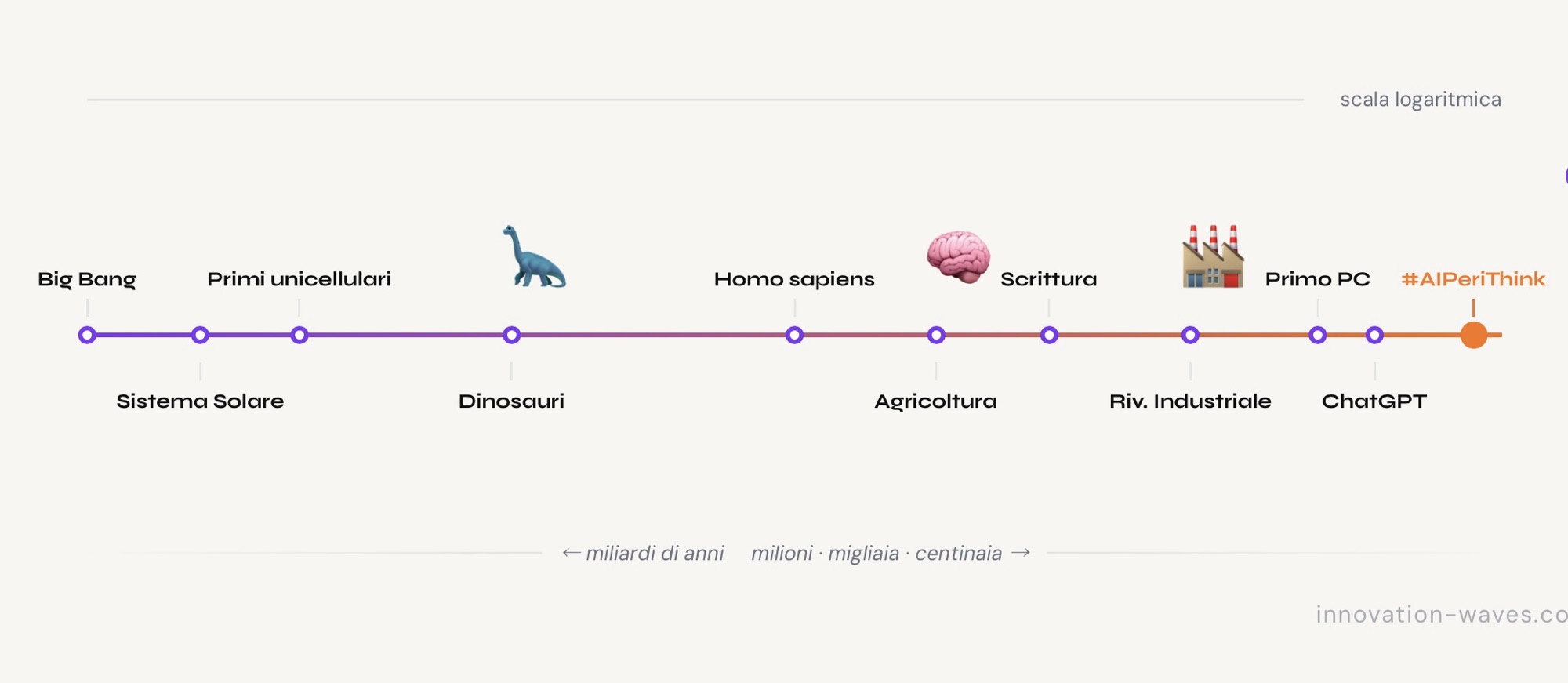
I recently gave a talk titled “Digital Orchestrators,” exploring the intersection of human evolution, technology, and the future of work (Here the full presentation). Looking back at the cosmic calendar, the acceleration is staggering. We spent millions of years just trying to survive, thousands building agriculture, and a few hundred industrializing. Now, we are in an era where the gap between the first PC and ChatGPT feels like a blink of an eye.
But while our technology has evolved exponentially, the institutions we work in have largely remained stuck in the past. And this friction is creating a profound crisis of meaning.
The evolution of why we work
If we look at the history of human labor, our motivations have shifted dramatically across three distinct eras:
| Era | Primary Motivation | The Core Question |
|---|---|---|
| Industrial Era | Survival | “Will I be able to feed my family?” |
| Information Era | Ambition | “Will I be able to build a career?” |
| Digital Era | Value / Purpose | “Is this work worth my time on earth?” |
The problem arises when people have evolved to seek value and purpose, but the institutions they work for are still operating on the operating system of the Information Era, or worse, the Industrial Era. When this happens, the best talent does not just complain. They leave. They seek an environment that matches their evolutionary stage.
Ambition vs. purpose: the zero-sum game
Ambition is inherently comparative. It requires someone else to be below you so you can be above them. It is a zero-sum game where your success often implies someone else’s failure. It is instrumental, creating a price on your soul, and often leads to emptiness once the goal is achieved.
Purpose, on the other hand, is intrinsic. It has value in itself. It is absolute and generative. It cannot be bought, and it brings meaning even in failure. The paradox of the modern workplace is that the most ambitious people often become the most unhappy, while those driven by purpose build the most sustainable value.
“With an ambitious man I can deal, he can be bought. But a man who wants nothing has no price.” (Re Euristeo, Ercole)
The speed of the average

Talent can be contagious, but large organizations often move at the speed of the average. The most productive resources reply to emails too quickly, deliver tasks too fast, and propose ideas too early. If other departments are not equally fast, the hyper-activity of the top performers hits a wall and fails.
Instead of incentivizing the rest of the organization to match the pace of the best, the company often pushes the most productive to slow down and conform to the average. The result: top talent becomes demotivated and leaves. We are systematically optimizing for mediocrity.
Ubiquity and the output-based future

Some companies still require employees to clock in, even for lunch breaks, just to guarantee 8 hours in the office. It is like a toxic relationship: a deep-rooted mistrust built over decades of bad relations between employers and employees.
“In a world where performance can be tracked and value measured, it seems absurd that most employment relationships are still based on a clock.”
The future of work is output-based. Value is no longer measured in hours sat at a desk, but in results produced. The new generation works for objectives, not for attendance. Smart working is not a benefit; it is a minimum condition for attracting talent. Where you are does not matter. What matters is that you are there, producing.
The rise of the digital orchestrator

We started in a world where working literally meant hunting to survive. We moved through the age of factories and cubicles, and now we have arrived at an era of remote work and AI colleagues. Tasks that used to require hours of human labor can now be executed by multiple AI agents in minutes.
This does not mean humans are obsolete. It means our role has fundamentally changed. We are no longer just executors. We are becoming Digital Orchestrators: people who design the systems, direct the AI agents, and ensure the output aligns with the overarching purpose. We have gone from using almost all our energy for survival tasks to using tiny fractions of it to produce 10x the output, thanks to machines and algorithms.
The question is no longer how many hours you can work, but how effectively you can orchestrate the tools at your disposal. The companies that understand this will attract the best talent. The ones that do not will keep optimizing for the average, until the average is all they have left.
Share your thoughts