
“It is a far, far better thing to have a firm anchor in nonsense than to put out on the troubled seas of thought.” – John Kenneth Galbraith
For the past few weeks, I’ve been wrestling with an uncomfortable idea: that the future is already decided by systemic pressures we refuse to acknowledge. But now a new stream of thoughts just crystallized this anxiety into a sharp, painful truth, especially for us Europeans.
I was born and raised across 4 key European countries [Luxemburg, France, England and Italy] in the late 80’s right when the Berlin wall fell and couldn’t avoid to buy into the romantic unifying vision of the European Union. Back then Europe seemed a promising concept destined to become more than the simple sum of its parts!
Fast forward many years later I found myself living back in the UK [for work] when Brexit happened. Back then I thought to myself “How the hell are we ever going to compete with China now?”.
I couldn’t be more wrong: the enemy within and who seemed to be our closest allies is what I should have been worried about. Now, in the light of recent geopolitical earthquakes I am starting to recognize a pattern that I don’t like, actually, it is slowly sucking all my positivity towards the “European Dream”.
We [the “old continent” that is] have been more or less passively accepting what’s happening around the world [wars] in recent years as a distant problem but something doesn’t feel quite right and rather than temporary glitches in the Matrix, these continuous tensions seem to be escalating rather than slowly fading out and indirectly influencing our own mood, and nothing gets more moody than politics.

The fact is that currently Europe is caught “between two fires,” a literal and metaphorical battlefield for the strategic interests of the United States and Russia. The core thesis is that both superpowers, for different reasons, actively prefer a divided, weakened Europe. They don’t want a peer competitor; they want a buffer zone, a market, a collection of client states. This isn’t much of a conspiracy theory but rather a rational analysis of power dynamics. And it leads to a conclusion that is both radical and unavoidable: the current structure of the European Union is designed to serve the interests of external powers, not Europeans themselves.
I’ll be direct here: The only way to escape this trap is to transform the EU into a genuine confederation of nations, a sovereign entity capable of choosing its own destiny.
There’s a lot to unpack to explain my thesis but allow me to deep dive into the forces working against us and see why confederation is not just an ideological dream, but a pragmatic necessity.
Chapter 1: A Puppet for the United States?
The United States wants a Europe that is strong enough to be a vital economic partner and a buffer against Russia, but not so united as to become a geopolitical rival. It’s the Goldilocks theory of foreign policy: not too weak, not too strong, but just right to serve American interests.
This is achieved, by a dual strategy. On one hand, the US maintains Europe’s security dependence through NATO, ensuring we remain a primary market for American military hardware. On the other, it subtly undermines political unity. Think of US National Security Strategy, which explicitly seems to outline a plan to “help Europe correct its current trajectory” by supporting “patriotic” [read: Eurosceptic] parties to keep the bloc internally divided [2].
Whether this is explicit policy or simply the emergent outcome of an “America First” mindset, the effect is the same. We saw it with the Trump administration’s tariffs and its shocking threats over Greenland, which treated NATO allies as adversaries [3]. We see it in the reality that, without US leadership, Europe is often paralyzed on the world stage.
“To be an enemy of America can be dangerous, but to be a friend is fatal.” – Henry Kissinger
This is not an anti-American argument. It is a pro-European one. The United States is acting in its own rational self-interest. The problem is that we are not. A confederation with a unified foreign policy and an independent military [a true European Army] is the only way to change this dynamic. It is the only way to transition from being a strategic asset for Washington to being a strategic actor in our own right.

Machiavelli understood this five centuries ago. In The Prince, he warned that relying on the arms of others is the surest path to ruin. “Mercenaries and auxiliaries are useless and dangerous,” he wrote. “If one holds his state based on these arms, he will stand neither firm nor safe.” Europe, in its dependence on American security guarantees, has become exactly the kind of state Machiavelli warned against: prosperous, perhaps, but fundamentally insecure, its fate resting in the hands of a foreign power whose interests are not our own.
Chapter 2: A Den of Vipers for Russia?
If the US wants a dependent Europe, Russia wants a chaotic one. This second chapter is focused on Moscow’s long-standing strategy of division by financially and ideologically supporting a constellation of Eurosceptic, nationalist, and far-right parties across the continent, Russia can effectively paralyze the EU from within.
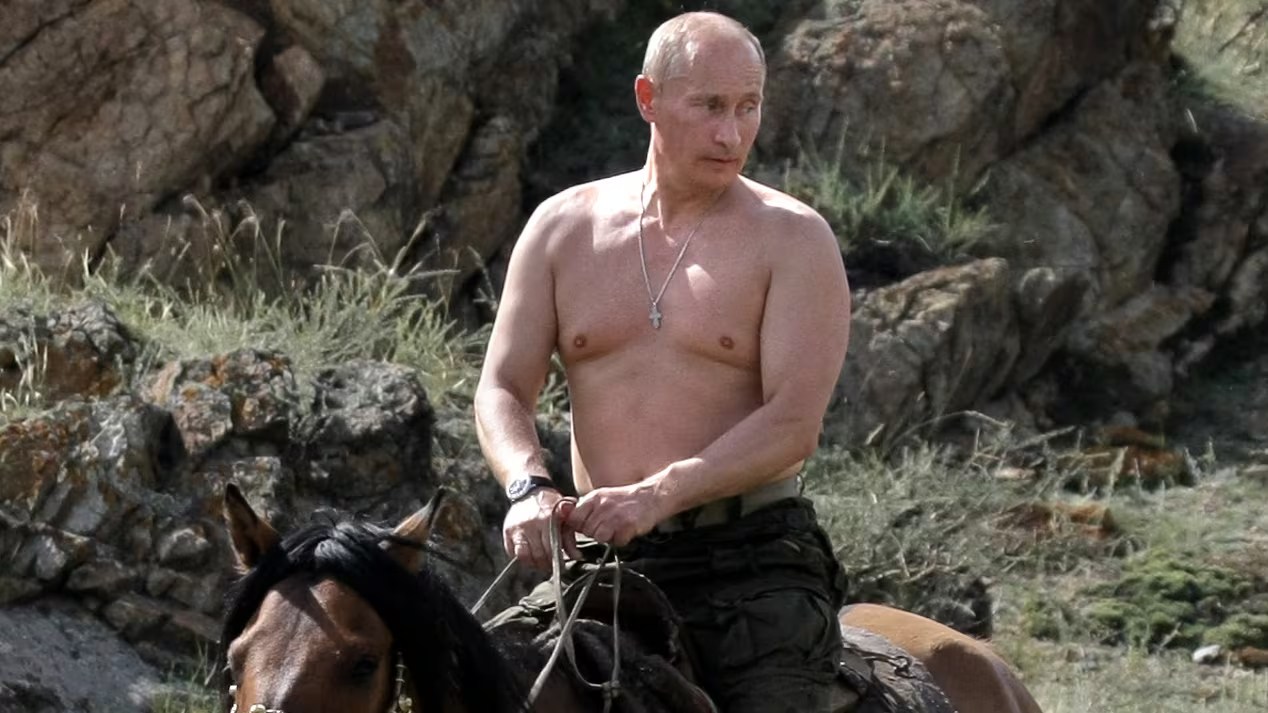
From Marine Le Pen in France to the AfD in Germany and various parties in Austria and Italy, the goal is the same: sow division, undermine trust in democratic institutions, and prevent a united European front [4]. A fragmented Europe cannot effectively counter Russian aggression, whether it’s the brutal war in Ukraine, hybrid warfare, or election interference.
The EU’s unanimity requirement for foreign policy is the key vulnerability that Russia exploits. It turns the bloc into a “covo di vipere” [a den of vipers], where a single pro-Russian government can veto any meaningful action, effectively holding the foreign policy of 450 million people hostage.
Antonio Gramsci, the Italian Marxist philosopher, wrote extensively about “cultural hegemony”: the idea that power is maintained not just through force, but through the control of ideas and narratives. Russia has understood this deeply. It doesn’t need to invade Western Europe; it just needs to shape the information environment, to make Europeans doubt their own institutions, their own values, their own future. A fragmented Europe is not just easier to manipulate; it is a Europe that has already lost the battle for its own soul.
Here, the case for confederation is brutally simple: abolish the national veto. In a confederation, foreign policy would be decided by a qualified majority [I know, I struggle too imagining who would be the qualified people but let’s focus on one problem at a time…]. This would not erase national interests, but it would prevent a single state, potentially acting on behalf of an external power, from sabotaging the collective security of the entire continent.
Chapter 3: Europe’s Dilemma: Our Self-Imposed Weakness
This third and most damning chapter turns the mirror on ourselves. External powers can only exploit the weaknesses that we allow to exist. And here in Europe there are definitely several critical, self-imposed vulnerabilities:

These are not separate issues; they are interconnected symptoms of a single disease: a lack of genuine political union. They are the cracks in our foundation that our adversaries so skillfully exploit.
The sociologist Niklas Luhmann described modern society as a system of interconnected subsystems, each operating according to its own logic. The problem with the EU is that it is a system designed for coordination, not for action. It can harmonize regulations and manage a single market, but it cannot act as a unified political entity because it was never designed to. Its very architecture (the unanimity rules, the rotating presidencies, the diffusion of power) was built to reassure nation-states that they were not surrendering sovereignty. The result is a structure that is sovereign in name only, powerful on paper but impotent in practice.
A confederation is the only holistic cure. It would mean a true Energy Union that invests massively in renewables and diversification, treating energy security as continental security. It would mean a European Army with joint procurement, ending the absurdity of having dozens of different, non-interoperable weapon systems. It would mean a streamlined political structure where a directly elected executive can make decisions quickly and effectively. And it would mean a new European narrative that can inspire citizens and give them a stake in a shared future, moving beyond the bureaucratic jargon of Brussels.
The Unavoidable Choice
The uncomfortable truth is that the European Union, in its current form, is a system perfectly designed to be managed by external powers. Its weaknesses are not bugs; they are features, for everyone except Europeans.
We are caught in a geopolitical trap of our own making. But as the philosopher Karl Popper noted, “The future is very open, and it depends on us, on all of us. It depends on what you and I and many other men and women are doing and will be doing, today, tomorrow, and the day after.”
The path to a confederation is fraught with difficulty. It requires a leap of faith that feels alien to our cynical age. It will likely begin with a “coalition of the willing”, a core group of nations forging ahead [like Belgium, Netherlands and Luxemburg did at the very beginning of this wonderful dream], and will face immense resistance from entrenched national interests.
But the alternative is no longer a comfortable status quo. The alternative is a slow slide into irrelevance, a future where Europe is not a global pole of power, but a curated museum and a managed market. The choice is between taking control of our own destiny or having it decided for us in Washington and Moscow.
For decades, we have put out on Galbraith’s “troubled seas of thought” and found no firm anchor. Perhaps the anchor is not a place, but a decision. The decision to finally become what we have so long pretended to be: united. The question I leave you with is this:
If both superpowers benefit from a weak Europe, who will build a strong one if not us?
References
[1] Nova Lectio. “Perché a nessuno conviene un’Europa forte e unita.” YouTube, 19 Jan. 2026,
[2] The White House. “National Security Strategy.” October 2025. (As referenced in the video).
[3] Wintour, Patrick. “Western alliance hangs in balance as Europe stiffens itself against Trump’s threats.” The Guardian, 18 Jan. 2026,
[4] Polyakova, Alina, and Daniel Fried. “Putin’s asymmetric assault on democracy in Russia and Europe.” Brookings Institution, January 2019,

Share your thoughts