
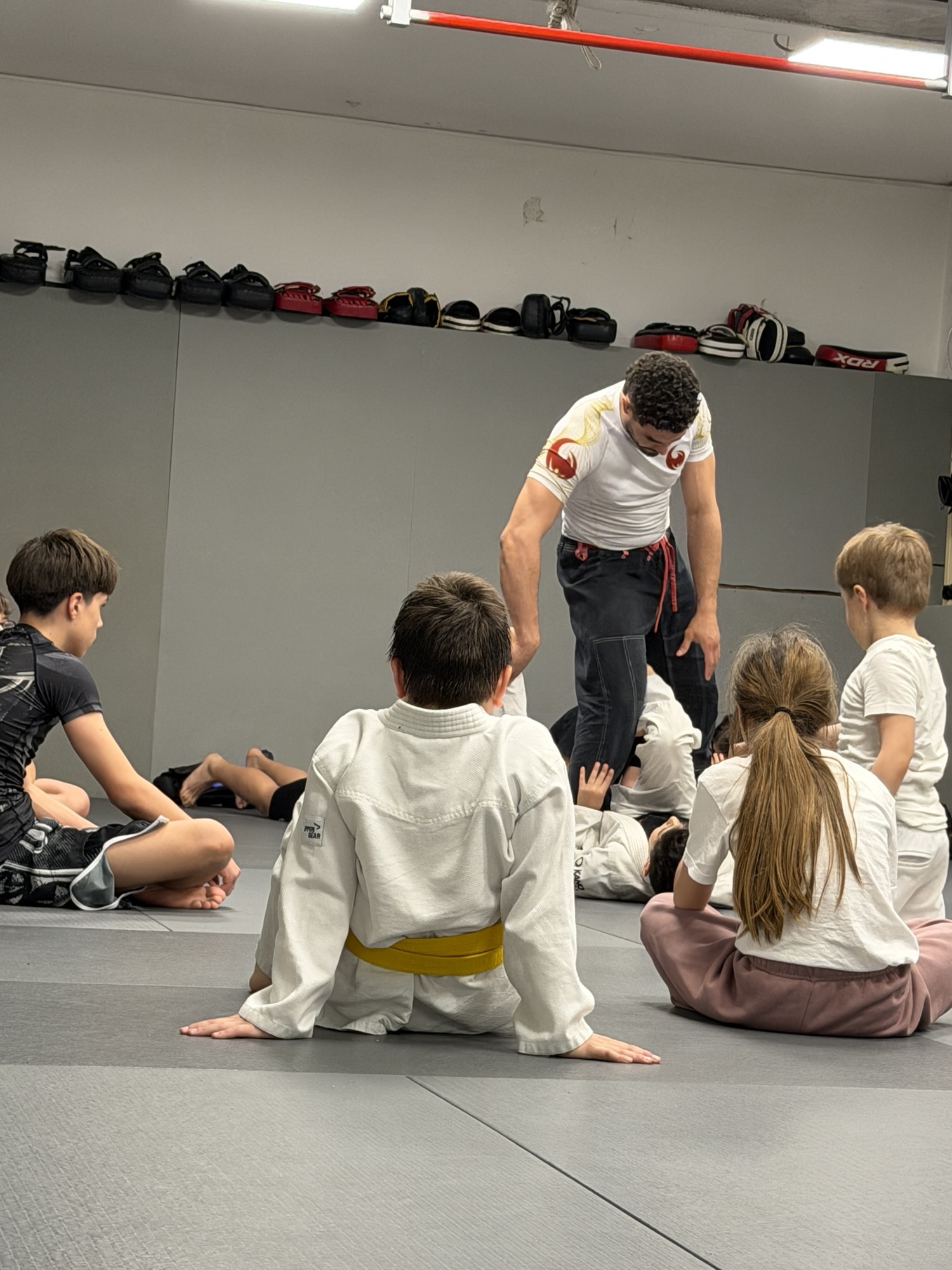
“The mind is not a vessel to be filled, but a fire to be kindled.” Plutarch’s ancient wisdom often comes to mind when I watch my seven-year-old son, Daniel, on the tatami.
Last Sunday, Daniel competed in his first Brazilian Jiu-Jitsu tournament. He didn’t win. But the real victory happened off the scoreboard. Later that evening, his instructor sent me a voice message that struck a chord: “You were worried he was almost too good-natured. But today, he understood when to flip the switch, put his head down, and go straight for the objective.”
At seven years old, he had instinctively learned to separate the game from the struggle, friendship from competition. He had found a way to regulate his impulses and channel his focus.
This got me thinking. If a neurotypical child can experience such a profound shift in self-regulation through martial arts, what happens when we apply this structured physical discipline to neurodivergent minds? What if the tatami is actually one of the most effective, yet overlooked, therapeutic environments we have?
The Neurodiversity Challenge
We live in a world designed for a very specific type of neurological processing. For children and adults on the autism spectrum (ASD), or those with Attention-Deficit/Hyperactivity Disorder (ADHD) and Sensory Processing Disorder (SPD), navigating this world is often exhausting.
Traditional physical education and team sports frequently fail to accommodate these diverse neurological profiles. The sensory overload of a basketball court, the complex, unstructured social dynamics of a soccer team, or the abstract instructions of a gym class can create barriers to participation, reinforcing feelings of exclusion.
But recent academic research is pointing toward an unexpected solution. A growing body of evidence suggests that martial arts, with their unique blend of physical exertion, rigid structure, and mindful repetition, offer profound cognitive and behavioral benefits for neurodivergent individuals [1].
The Architecture of Focus
A recent narrative review by Costanza et al. (2025) from the University of Palermo synthesized findings from multiple peer-reviewed studies examining martial arts practices in populations diagnosed with ADHD [2]. The results are striking.
Interventions based on disciplines like judo, taekwondo, and karate were consistently associated with significant improvements in attention, working memory, and inhibitory control.
Why does this happen? The answer lies in the architecture of the practice itself.
| Traditional Team Sports | Martial Arts Practice |
|---|---|
| Highly variable environments | Highly structured, predictable environments |
| Complex, multi-party social dynamics | Clear, dyadic (one-on-one) interactions |
| Abstract strategic goals | Concrete, mastery-based progression (belts) |
| High sensory unpredictability | Controlled sensory input |
Martial arts inherently require controlling impulses. You cannot succeed in judo or Brazilian Jiu-Jitsu without learning to inhibit the urge to react wildly. You must observe, wait, and execute with precision. For a brain that struggles with executive function and impulsivity, the dojo provides a safe laboratory to practice self-regulation.
The Proprioceptive Anchor
Beyond executive function, there is a deeply physical component to why martial arts resonate with neurodivergent individuals, particularly those on the autism spectrum.
A 2021 study by Phung and Goldberg investigated the effects of Mixed Martial Arts (MMA) training on boys with ASD [3]. They found a significant increase in positive social behaviors and a decrease in problematic behaviors.
One of the key mechanisms identified was the nature of the physical interaction. In martial arts, particularly grappling arts like BJJ, there is a constant exchange of deep pressure and proprioceptive input. For individuals with Sensory Processing Disorder, this kind of heavy, grounding physical contact is often deeply regulating. It acts as an anchor for a nervous system that might otherwise feel adrift in a sea of overwhelming stimuli.
Furthermore, the study highlighted the importance of “partner-drilling.” Unlike team sports where interaction is fluid and chaotic, martial arts partner work is highly structured. It requires imitation, non-verbal communication, turn-taking, and perspective-taking, all within a clear set of rules. It is, essentially, a physical masterclass in social skills.
The Epigenetic Frontier
Perhaps the most fascinating aspect of the Costanza review is the exploration of potential epigenetic effects [2]. While direct evidence is still emerging, the hypothesis is that the specific type of physical activity involved in martial arts might actually influence gene expression.
Through mechanisms like DNA methylation and histone modifications, the structured, mindful movement of martial arts could be altering the biological foundations of neurodevelopment. We are moving beyond the idea that exercise simply “burns off energy.” We are looking at physical practice as a tool that can literally rewire the brain at a molecular level.
This is why specialized programs are beginning to emerge. Initiatives like the “Brazilian Jiu-Jitsu for Neurodiversity” program in the UK are pioneering evidence-informed approaches, creating sensory-aware training environments and therapeutically informed coaching specifically tailored for neurodivergent youth [4].
The Orchestration of the Self
We spend a lot of time in the corporate world talking about “orchestration”, how to manage complex systems, align diverse teams, and optimize outputs. But the most fundamental orchestration is internal. It is the ability to regulate one’s own nervous system, to focus attention, and to navigate the physical and social world with intention.
Martial arts teach this internal orchestration. They do not try to “cure” neurodivergence. Instead, they provide a framework, a physical and mental scaffolding, that allows diverse minds to harness their unique strengths.
When Daniel stepped onto the tatami, he wasn’t just learning how to grapple. He was learning how to orchestrate his own responses. For neurodivergent individuals, that same tatami might just be the most powerful classroom they ever enter.
The question we must ask ourselves as parents, educators, and leaders is this: are we building environments that force diverse minds to conform to a rigid standard, or are we providing the scaffolding they need to master their own unique potential?
References
[1] Zehr, E. P. (2025). Can Martial Arts Help Kids on the Autism Spectrum? Psychology Today. https://www.psychologytoday.com/us/blog/black-belt-brain/202503/can-martial-arts-help-kids-on-the-autism-spectrum
[2] Costanza, C., et al. (2025). Martial Arts and ADHD: A Narrative Review of Cognitive, Behavioral, and Epigenetic Effects. Physical Education Theory and Methodology, 25(3), 26-33. https://doi.org/10.17309/tmfv.2025.3.26
[3] Phung, J. N., & Goldberg, W. A. (2021). Mixed martial arts training improves social skills and lessens problem behaviors in boys with Autism Spectrum Disorder. Research in Autism Spectrum Disorders, 83, 101758. https://doi.org/10.1016/j.rasd.2021.101758
[4] Holt, S. (2026). Brazilian Jiu-Jitsu for Neurodiversity. Insight Studio. https://www.insightstudio.uk/projects/bjj-neurodiversity
Share your thoughts