
“Every generation has had its technology to fear. Socrates was convinced that writing would destroy human memory. Our grandparents were certain television would lobotomise their children. Today, it is our turn.” Fabrizio Rinaldi – Raising Humans
I woke up one morning with a tight chest. I was looking at my seven-year-old son, Daniel, swiping through a screen with the kind of intuitive fluency that took my generation decades to learn. As someone who has spent over sixteen years navigating digital transformation for global brands, I should have felt comfortable. Instead, I felt the exact same anxiety that every parent feels today: Are we doing the right thing?

We are raising children at the epicentre of the greatest technological shift since the printing press, with no map and no compass. The algorithms are getting smarter, the screens are getting more immersive, and the traditional advice “just limit screen time” feels increasingly like trying to hold back the ocean with a sieve.
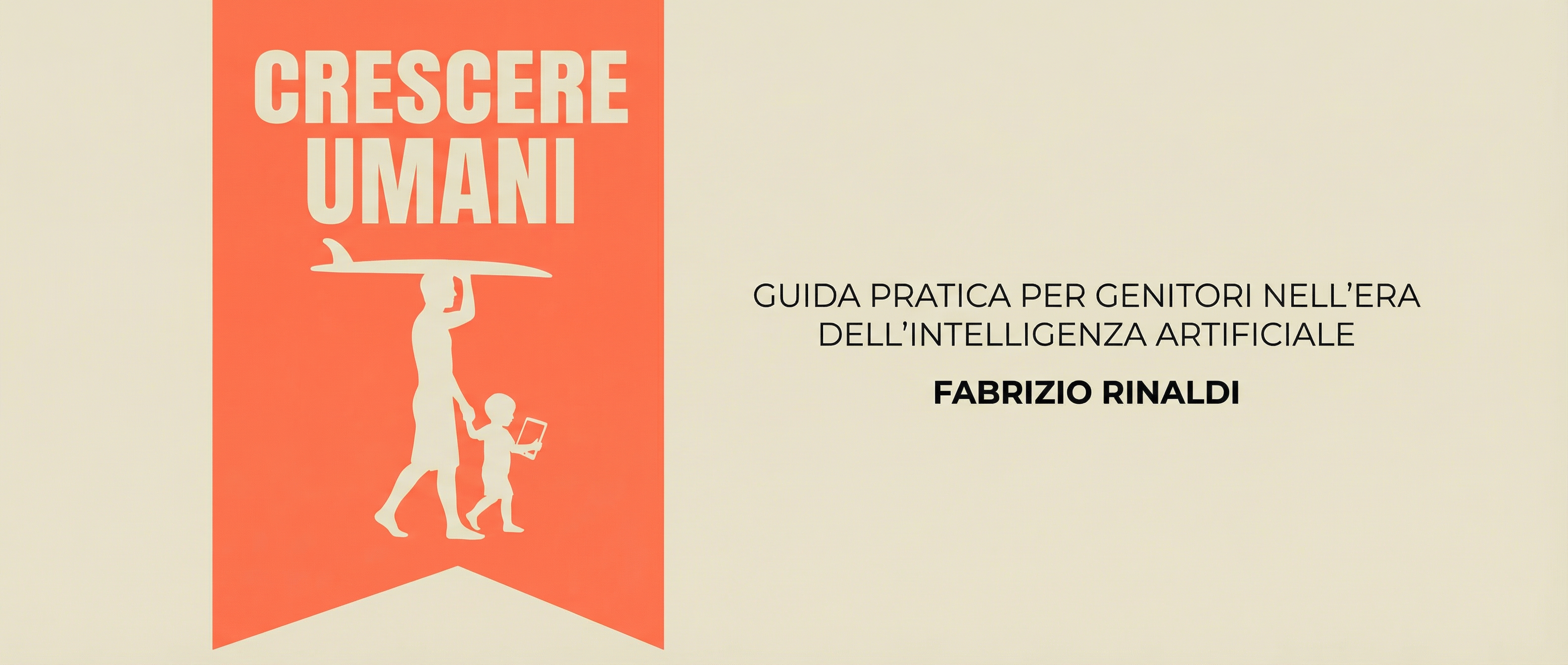
That morning was the genesis of my new book, Raising Humans: A Practical Guide for Parents in the Age of Artificial Intelligence [The book is now available on Amazon in Italian and English in both paperback or digital version.]. It is not a manual on parental controls or digital detoxes. It is an attempt to answer a much deeper, almost philosophical question: how do we raise children who are resilient, curious, morally grounded, and deeply human in a world increasingly shaped by machines?
The Myth of the Digital Native
For years, we’ve comforted ourselves with the idea that our children are “digital natives.” We assume that because they can operate an iPad at age three, they inherently understand the digital world.
But as I delved into the latest research in neuroscience and developmental psychology, a different picture emerged. Fluency is not literacy. A child who can swipe a screen does not necessarily understand the persuasive design, the dopamine loops, or the algorithmic biases operating beneath the glass.
This is where the concept of the Orchestrator Parent comes in. In the book, I argue that we need to move away from the binary roles of the “Controller” (who bans technology out of fear) and the “Bystander” (who abdicates responsibility to the machine). The Orchestrator Parent curates the environment. They don’t just manage screen time; they manage the context in which technology is introduced.
The Architecture of the Book
I structured Raising Humans not as a technical manual, but as a progression from the biological to the societal, and finally to the future.
| Part | Core Focus | The Central Question |
| 1. The Foundations | Mind, Body, and Soul | How does a child’s brain actually develop, and why do mud, sweat, and moral grounding matter more than ever? |
| 2. The Tool | Technology as a Window | How do we transition from passive consumption to active, critical use of digital tools? |
| 3. The Education | The Changing School | When AI can tutor anyone, what is the true purpose of the physical classroom? |
| 4. The Future | Skills for the 21st Century | What makes us irreplaceable when machines can do almost everything else? |
The Meaning Crisis and the Moral Compass
One of the most challenging chapters to write was about the intersection of technology and morality. We live in an era of algorithmic acceleration, where AI promises to optimize everything. But as the philosopher John Vervaeke points out, we are in the midst of a “Meaning Crisis.”
AI can summarize a book in three seconds, but it cannot explain to a teenager why it is worth getting out of bed in the morning. It cannot teach them to distinguish right from wrong when no one is watching.
If a child lacks a solid moral foundation, what I call the “moral compass”, the internet quickly transforms from a tool of exploration into a labyrinth of mirrors. This is why the book heavily emphasizes the need for “vertical idols” (mentors, coaches, and present parents) to counteract the horizontal tyranny of peer orientation that social media accelerates.
The Placebo Effect of Learning
When we look at education, the temptation is to chase technological innovation for its own sake. But as Ruhma Yusuf, founder of Little Genius International and creator of the ICE® method (who graciously wrote the foreword to the book), points out, we risk falling into the “placebo effect” of learning.
A temporary spike in attention driven purely by the novelty of a new AI tool is not pedagogical improvement. Technology only works when accompanied by deep teacher training and a precise definition of its educational scope. The human element must always take precedence.
The future does not belong to those who know how to use machines. It belongs to those who know how to remain profoundly human while orchestrating them. Raising Humans is my attempt to map out what that looks like in practice. It is not a book of rules, but an invitation to ask better questions. Because parents who ask questions are already, from the very start, the parents their children need.
Share your thoughts