
“The Palantíri were not evil… But those who looked into them saw only what they were strong enough to see. And the strong could also be deluded.”J.R.R. Tolkien, The Silmarillion
I recently came across a fascinating video by one of my fav YouTube channels (👉🏼Nova Lectio) that sent me down a rabbit hole I’m still trying to climb out of. The subject was Palantir, a company that most people have heard of but few truly understand. And the more I dug, the more I realized this isn’t just a tech company. It’s a philosophical project, a political statement, and a chillingly accurate reflection of our times, all disguised as a software firm.
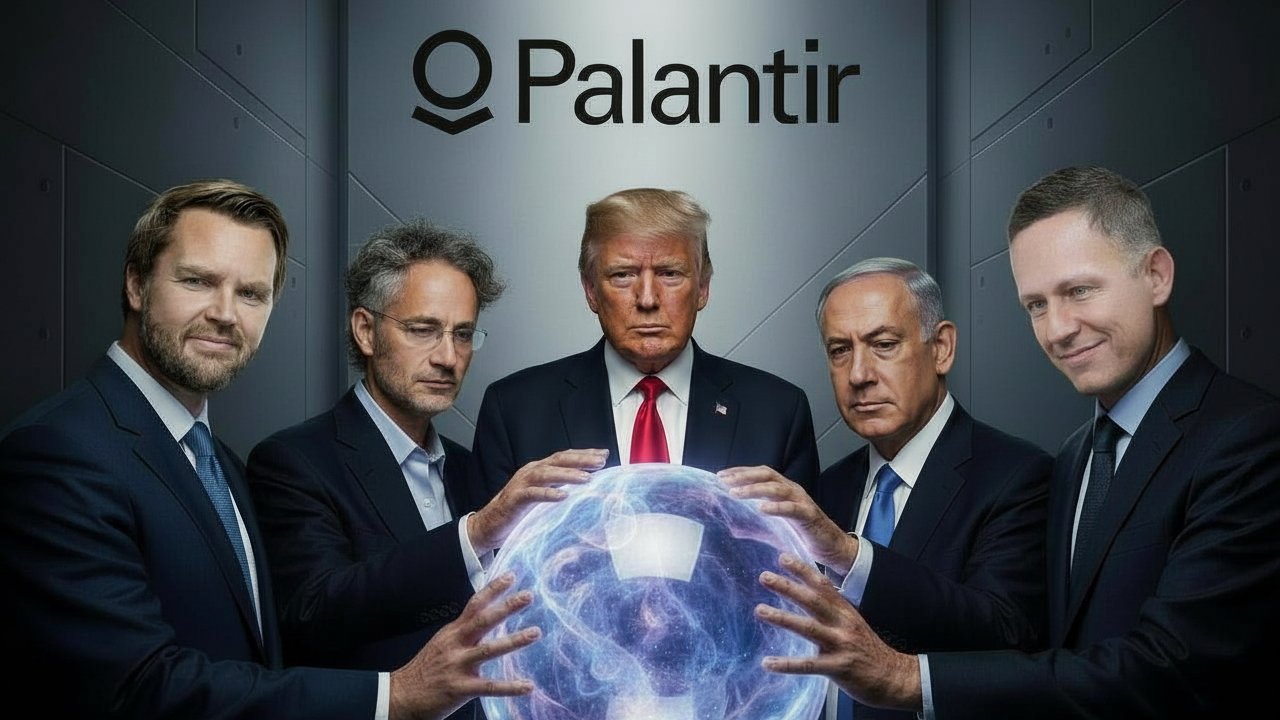
The name itself is a dead giveaway. In Tolkien’s Lord of the Rings, the Palantíri were the “seeing stones,” ancient artifacts that allowed their users to see across vast distances and even into the minds of others. They were tools of immense power, but also immense danger. They didn’t create evil, but they amplified the intentions of those who wielded them. It’s the perfect metaphor for the company Peter Thiel and his co-founders built, and it’s a warning we should all be taking very seriously.
Chapter 1: One Tech Company to Rule Them All
To understand Palantir, you have to understand the world it was born into. The year was 2003. The dust from 9/11 had not yet settled, and the US government was pouring billions into a new, shadowy world of mass surveillance. It was in this climate that Peter Thiel, fresh off his success with PayPal, founded Palantir with a singular vision: to create a software platform that could connect the dots, find the patterns, and see the threats that were hiding in plain sight.

His first and most important customer was the CIA, through its venture capital arm, In-Q-Tel. This wasn’t a typical startup; it was a shadow-ops tech company from day one. And its business model was deceptively simple. Palantir doesn’t collect data. It doesn’t have its own servers full of your personal information. Instead, it provides the tools for others to analyze their own vast, disconnected datasets. Its two main platforms, Gotham (for government and intelligence) and Foundry (for corporations), are designed to be the operating system for data-driven decision making.
This is not a niche business. Palantir’s software is used by the FBI, the NSA, the IDF, and a growing list of Fortune 500 companies. And Thiel’s obsession with Tolkien’s world doesn’t stop with the company name. His other ventures include Mithril Capital (named after the mythical elven metal) and Anduril Industries (named after Aragorn’s sword), a defense tech company that builds autonomous drones and weapons systems. This isn’t just branding; it’s a statement of intent. Thiel and his cohort see themselves as the forgers of a new, technologically superior West.
Chapter 2: Helm’s Deep
This brings us to the defensive argument for Palantir’s existence, the “Helm’s Deep” of their corporate strategy. In a dangerous and chaotic world, they argue, the West needs every advantage it can get. And that means having the most advanced, most lethal, and most intelligent weapons systems on the planet.
This philosophy is perfectly encapsulated by Palantir’s eccentric CEO, Alex Karp. In a now-famous interview, he stated that providing the West with the most effective weapons is the “best solution to war.” It’s a stark, utilitarian argument that cuts through the usual corporate platitudes. Palantir doesn’t pretend to be a neutral platform; it is an active participant in the geopolitical power struggles of the 21st century.

We are seeing this play out in real-time. Palantir’s software is being used on the battlefields of Ukraine and in the current conflict with Iran. It is the invisible backbone of modern warfare, a system that can track troop movements, analyze drone footage, and predict enemy behavior. And the market is rewarding them for it. Palantir’s stock has surged in recent months, a clear indication that in a world of increasing instability, the business of war is booming.
Chapter 3: Being Saruman, Being Gandalf
This is where the story takes a darker turn. The power to see everything is also the power to control everything. And this is the central tension at the heart of Palantir: the choice between being Saruman or being Gandalf.
Saruman, in Tolkien’s world, was a wise and powerful wizard who became corrupted by his use of the Palantír. He believed that the only way to defeat the enemy was to become like him, to centralize power, to control, to dominate. Gandalf, on the other hand, understood that true strength lies in decentralization, in freedom, in the courage of ordinary people.

Palantir’s ultimate vision, as articulated by Thiel and Karp, is a form of “algocracy”: a society governed not by the messy, unpredictable process of democracy, but by the cold, hard logic of algorithms. It’s a world where the most important decisions are made by a select few who have access to the all-seeing eye. It’s a world where security is prioritized over freedom, where dissent is seen as a threat, where the individual is subordinate to the system.
This is not a hypothetical future; it is the world we are rapidly building. And it raises a profoundly unsettling question: when a private company has more intelligence-gathering and analytical power than most nation-states, who holds them accountable? Who watches the watchers?
The Eye is Always Watching
The story of Palantir is the story of our time. It is a story about the seductive allure of power, the dangerous promise of total information awareness, and the timeless struggle between freedom and control. It’s a story that forces us to confront the uncomfortable truth that the tools we create to protect ourselves can also be the tools that enslave us.
The Palantíri of Tolkien’s world were not inherently evil. They were simply amplifiers of intent. They showed you what you were strong enough to see. The same is true of Palantir’s software. It is a mirror that reflects the values and ambitions of those who wield it.
And that leaves us with one final, chilling question. In a world where the all-seeing stone exists, and is in the hands of the powerful, who is Sauron?

Share your thoughts