
I’ve had the chance to study countless innovations over the years, but few have excited me as much as what I’m about to share with you. Imagine being able to communicate with your devices, with artificial intelligence, and even with other people, simply through thought. Science fiction? Until yesterday, perhaps. Today, thanks to Alterego, this vision is about to become reality.
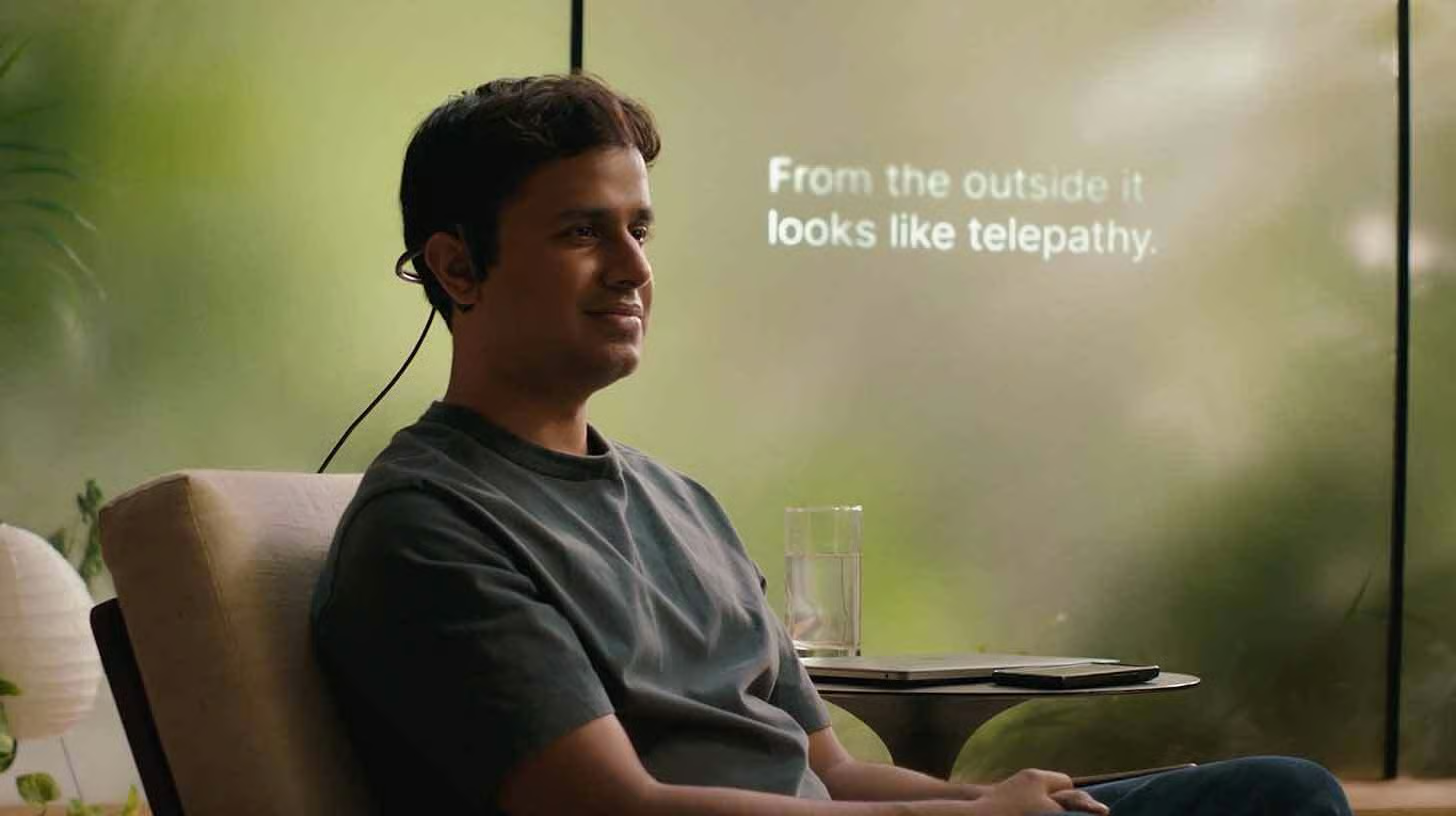
Born from pioneering research at MIT Media Lab, Alterego presents itself as the world’s first “near-telepathic” interface. A minimalist, non-invasive wearable that promises to make technology a natural extension of our mind, allowing us to interact at the speed of thought. We’re not talking about mind reading, let’s be clear. The technology, dubbed Silent Sense, detects the signals our brain sends to the vocal system before words are even spoken. In practice, it captures the intention to speak, even if we remain silent.
The founders, Arnav Kapur and Max Newlon, don’t simply want to create a new gadget, but to inaugurate a new era of human-computer interaction, what they define as the “intelligence age.” An era where the barriers between mind and machine thin out, freeing us from the slavery of keyboards, touchscreens, and awkward voice commands.
In this article, we’ll explore together how Alterego works, what it will allow us to do, and most importantly, what strategic implications this technology will have for the future of work, communication, and our very cognition.
How It Works: The Magic of “Silent Sense”
The real magic of Alterego lies in its proprietary technology, Silent Sense. Unlike invasive brain-computer interfaces (BCIs) that require surgical implants, or electroencephalography (EEG) technologies that read brain activity more generically, Alterego focuses on a very specific signal: subvocalization.
When we think about speaking, even without moving our lips, our brain sends imperceptible neuromuscular signals to the muscles of the face and throat. Alterego, through a series of sensors in contact with the skin, is able to capture these signals with extraordinary precision and translate them into digital commands. The system is so sensitive that it can detect the entire spectrum of speech: from that pronounced aloud, to simple lip movement, to the completely motionless intention to speak.
This approach has two enormous advantages:
1.Total Privacy: Alterego doesn’t read thoughts. It only records what the user consciously intends to say, by activating their internal vocal system. Our private thoughts remain private. It’s a fundamental distinction that directly addresses one of the major ethical concerns related to neurotechnologies.
2.Intuitive Interface: There’s no need to learn complex commands. The interaction is based on language, the most natural form of communication for humans.
What will we be able to do, in practice, with Alterego? The possibilities are staggering:
• Type at the speed of thought: Write emails, messages, or take notes without needing a keyboard.
• Silent Search: Search for information on the internet discreetly, during a meeting or in a public place.
• Hands-Free Control: Manage apps, smart home devices, and other devices without using hands.
• Voice Augmented Reality: Ask questions about the world around us and receive audio responses directly from Alterego, thanks to integrated cameras in the device.
• Private Conversations: Dialogue with another person wearing Alterego in a completely silent way, like a telepathic chat.
Beyond the Gadget: A New Category of Interfaces for the “Intelligence Age”
As an innovation consultant, what excites me most about Alterego isn’t so much the device itself, but the new category of interfaces it inaugurates. We’re entering what the founders call the “intelligence age,” an era where artificial intelligence is no longer an external tool to consult, but a partner to collaborate with in real-time. To do this, we need a much faster and more direct communication channel than the current one: we need a broadband interface for our mind.
Alterego proposes itself as this interface. It’s a bridge between human cognition and artificial intelligence, allowing a bidirectional and frictionless flow of information. This opens revolutionary strategic scenarios in many sectors:
• Productivity and Work: Imagine a surgeon who can consult data and images during an operation without taking their hands off the patient, or a technician who can visualize manuals and diagrams while repairing complex machinery. The ability to access information and control systems hands-free and screen-free could exponentially increase efficiency and safety in many professional fields.
• Accessibility: For people with motor or speech disabilities, Alterego represents concrete hope. The possibility of communicating and interacting with the digital world through subvocalized thought could break down barriers that today seem insurmountable.
• Creativity and Learning: Freed from the need to stop to write or type, we could capture ideas and information at the very moment they form in our mind. Learning could become more immersive, with the possibility of asking questions and receiving answers while observing a work of art or visiting a historical site.
The Visionaries Behind the Revolution: Arnav Kapur and Max Newlon

Behind every great innovation there are always extraordinary people, and Alterego is no exception. The two founders, Arnav Kapur and Max Newlon, represent the perfect combination of scientific vision and entrepreneurial acumen.
Arnav Kapur, CEO and co-founder, is the true pioneer of silent speech interfaces. At MIT Media Lab he literally invented this category, developing the first versions of Alterego and establishing a new paradigm for neural conversational systems. His curriculum is impressive: recognitions like TIME Best Inventions, the prestigious Lemelson-MIT Graduate Prize, and the Beazley Design Award. But what strikes me most is his holistic vision: Arnav doesn’t see AI as a substitute for human intelligence, but as a complement. His artistic installations exhibited at Tate Modern and the Design Museum demonstrate how he manages to combine technology and humanity in a poetic way.
Max Newlon, COO and co-founder, brings the entrepreneurial experience necessary to transform revolutionary research into a scalable business. As former President of BrainCo, he has already demonstrated his ability to grow a neurotech startup from zero to a $1 billion valuation. His Harvard training in human development and adult growth psychology gives him a unique perspective on how technologies can enhance human potential without distorting it.
Together, they represent that rare combination of deep technical competence and human sensitivity that is essential when working with such intimate and powerful technologies. They’re not just building a product, they’re defining the ethical and philosophical principles of a new era of human-machine interaction.
The Strategic Question: Are We Ready to Become Cyborgs?
The arrival of technologies like Alterego inevitably raises profound questions. Are we ready for such intimate integration with artificial intelligence? What does it mean for our identity, for our ability to concentrate, for our human relationships?
My vision is that, as with every great technological leap, the key will be in awareness and ethical design. Alterego’s approach, which puts user privacy and intentionality first, is an excellent starting point. It’s not about becoming passive cyborgs, but about augmenting our capabilities, extending our mind.
The real challenge for companies and society won’t be so much adopting these technologies, but integrating them in ways that enhance our humanity, instead of diminishing it. The brands that know how to design experiences and services that leverage this new human-machine symbiosis in meaningful and respectful ways will be tomorrow’s leaders.
Alterego is only at the beginning of its journey, but it has already charted a clear course. The future of human-computer interaction will no longer be visible, but will hide in the silence of our thoughts. And I can’t wait to see what we’ll be able to create.
What do you think? Are you ready to speak with your inner voice? Let’s discuss it in the comments! 👇