
What you’re about to read is the result of a thought experiment taken seriously: what if a spiritual leader like the Pope became the catalyst for peace in one of the world’s most intractable conflicts? Combining the perspectives of a UN peacekeeping strategist, a military general, and an ethicist, this article explores an idea that blends moral courage with diplomatic realism. It’s not just fiction – it’s a blueprint for what peace innovation could look like.

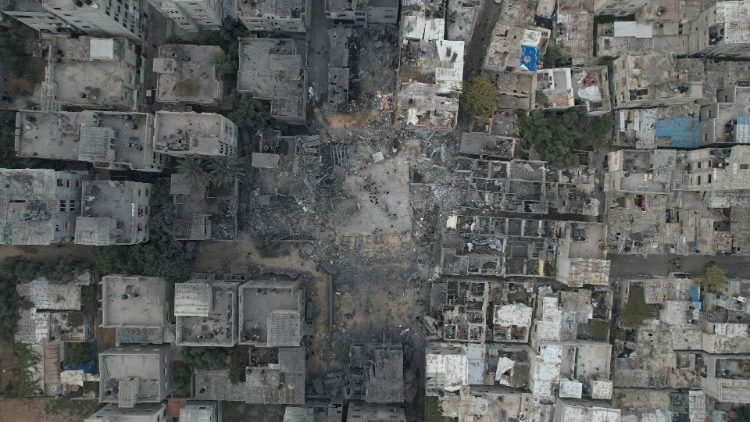
An aerial view of destruction in a Gaza neighborhood after months of conflict – a stark reminder of the urgent humanitarian crisis that Pope Francis seeks to address with his unprecedented peace initiative.
In this simulation, on April 21, 2025, the Pope (Francis in the simulation) issues an extraordinary mission statement declaring his intent to personally travel to the Gaza Strip and remain there until a credible peace agreement is reached. This bold pledge comes after over 18 months of devastating conflict following Hamas’s brutal attack on Israel in October 2023. The ensuing war has exacted a staggering toll: more than 1,200 Israelis were killed in the initial assault, and Israel’s military campaign in Gaza has killed over 47,000 Palestinians, the majority women and children. Neighborhoods lie in ruins, hospitals struggle without supplies, and an entire population teeters on the brink of despair. In this context, Pope Francis – who has been one of the world’s most consistent moral voices for de-escalation – is now taking an unconventional step that could reshape peacemaking efforts. He has consistently called for an immediate ceasefire and insisted that “war is always a defeat… a destruction of human fraternity”. By placing himself in Gaza as a human shield of conscience, the pontiff aims to halt the bloodshed and catalyze negotiations through the power of nonviolent presence and moral authority.
This policy brief outlines how Pope Francis’s presence in Gaza could serve as the anchor for a broader international humanitarian ceasefire effort. We examine the diplomatic rationale behind this initiative, propose a realistic roadmap for implementation involving key international institutions, assess the potential risks (and strategies to mitigate them), and consider the broader significance of this move as a new model of unconventional peacekeeping and “moral diplomacy.” While inherently extraordinary, the Pope’s Gaza mission may offer a desperately needed catalyst for peace in the Israel-Palestine conflict and a template for nonviolent intervention in conflicts elsewhere.
Background: A Conflict at a Cruel Impasse
The Israel–Hamas war that erupted in 2023 has created one of the worst humanitarian crises in recent memory. Following Hamas’s surprise attack of October 7, 2023, which targeted Israeli civilians and took some 250 hostages, Israel launched a massive military offensive in Gaza. The fighting has been characterized by indiscriminate rocket fire and overwhelming firepower in dense urban areas, leading to catastrophic civilian casualties. International law requires the protection of civilians and the provision of relief, yet on the ground these norms have given way to siege and bombardment. By early 2025, Gaza’s suffering reached grave levels: entire city blocks reduced to rubble, over half the population displaced, and basic infrastructure (water, electricity, hospitals) largely incapacitated. United Nations agencies warned that Gaza’s 2.3 million residents are in extreme peril, with food and medicine running out and thousands of injured in need of care. Israel, citing the imperative to destroy Hamas, continued offensive operations, while Hamas and other militias sporadically fired rockets into Israel. Diplomatic efforts yielded only brief pauses. A long-term ceasefire agreement brokered by regional powers in January 2025 offered a glimmer of hope, but implementation proved fragile and intermittent. Trust between the parties is virtually non-existent, and traditional diplomacy has stalled, mired in mutual suspicion and the absence of a neutral guarantor on the ground.
Amid this impasse, Pope Francis has emerged as a singular voice of conscience. Throughout the conflict he has pleaded for nonviolence and humanitarian relief. Notably, he has been in daily contact with Gaza’s small Catholic parish and other residents, hearing first-hand accounts of the suffering. In public statements from Rome, the Pope expressed heartbreak at scenes of children killed and neighborhoods obliterated, at one point exclaiming “It’s too much!” and lamenting the lack of any concrete peace efforts. He has called repeatedly for opening humanitarian corridors and releasing hostages on all sides. Despite his age (88) and a recent serious illness, Francis has signaled a willingness to “go to the very limit” for peace. His mission statement to go to Gaza is a culmination of this moral advocacy – moving from words to a dramatic act of physical solidarity.
The Papal Initiative: A Moral Anchor for Ceasefire
Pope Francis’s decision to embed himself in Gaza as a “pilgrim of peace” is without modern precedent. The initiative can be understood as an attempt to provide what the conflict desperately lacks: a trusted, neutral witness on the ground whose very presence exerts pressure on all parties to stand down. The Pope’s plan is to remain in Gaza until a credible peace agreement is reached, effectively staking his life and moral authority on the pursuit of peace. How could this unprecedented act change the dynamics?

First, the Pope’s presence would serve as a powerful nonviolent deterrent against further attacks. Neither the Israeli military nor Palestinian armed groups would want to be responsible – directly or indirectly – for harming the Pope. His global stature means any violence that endangers him would incur immediate and universal condemnation. In effect, his body becomes a human buffer between warring sides. Historical examples suggest that unarmed observers can indeed reduce violence: for instance, teams of international volunteers in conflict zones have often deterred attacks simply by standing with vulnerable civilians, creating what one analyst calls a “deterrent effect” through moral pressure. Pope Francis’s singular prominence amplifies this effect enormously. As one of the world’s most respected religious leaders – a figure widely seen as holy and impartial – his safety would be a red line. This could compel Israeli forces to substantially restrain aerial bombardments and artillery for fear of an accident, and likewise could discourage any militant provocations that might escalate fighting around him. In essence, the Pope becomes a living “ceasefire line”, not enforced by weapons or UN troops, but by the force of moral authority and global public opinion.
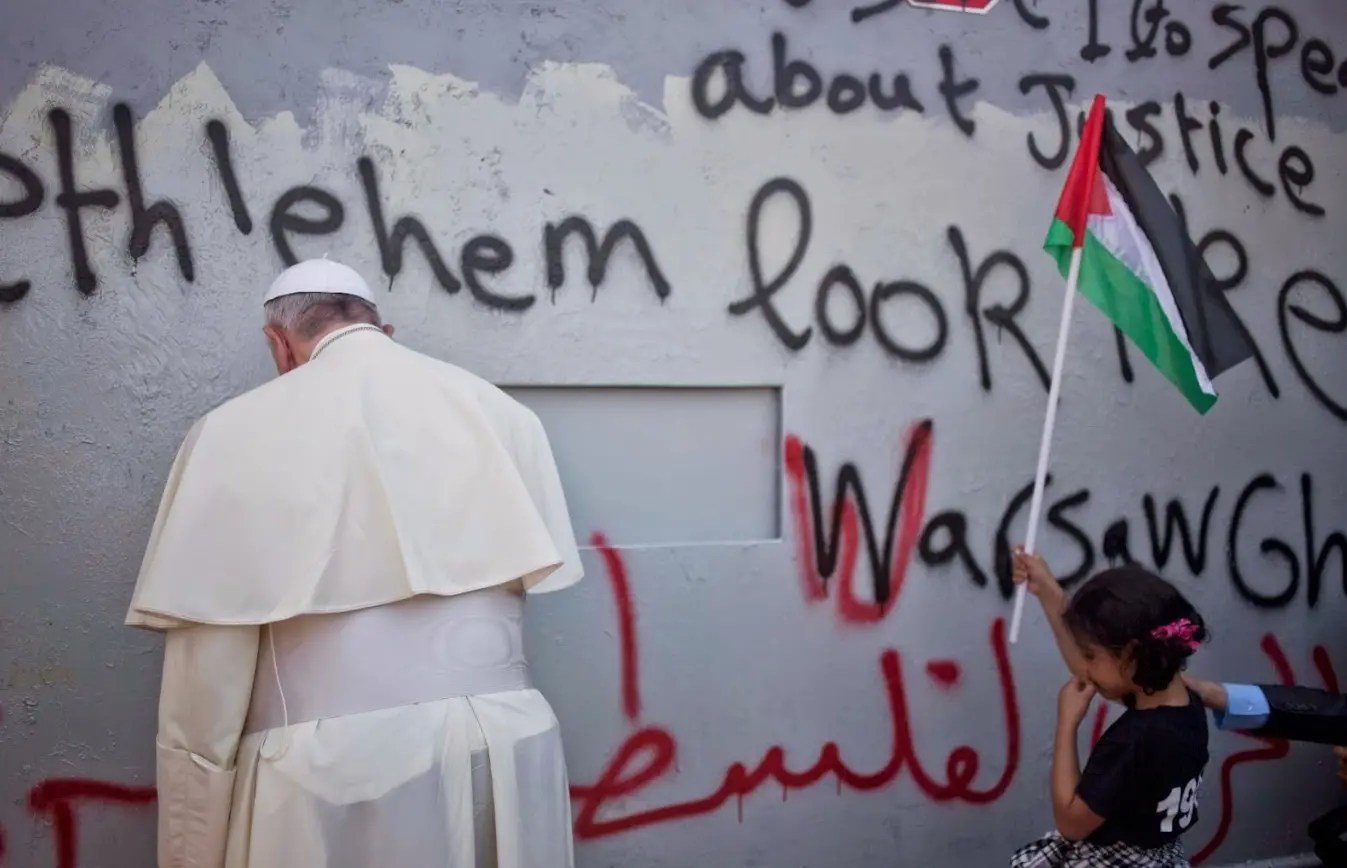
Second, the Pope’s initiative could jump-start diplomacy by focusing international attention and empathy. His standing in Gaza would not be a solitary gesture; it would come with the Vatican’s diplomatic weight and the personal engagement of a leader known for bridging divides. Pope Francis has a track record of using moral symbolism to spur negotiations – for example, in 2019 he famously kissed the feet of South Sudan’s rival leaders to implore them to keep their peace agreement, and he helped facilitate dialogue in the Colombia and Cuba–US peace processes. In Gaza, his ongoing presence would continuously shine the global spotlight on the plight of civilians, maintaining pressure for a political solution even as news cycles move on. It would also provide a focal point for dialogue: the Pope could act as a go-between or listener to all sides, even if informally. While he is not inserting himself as a formal mediator, his impartial compassion might open channels of communication. Both Israeli and Palestinian publics might feel encouraged by an approach that transcends politics and speaks to shared humanity – potentially empowering moderates on each side. The very image of the Pope praying amid ruins or comforting victims could soften hardened attitudes and create a catalytic atmosphere for peace talks. As the editor of a Catholic peace initiative observed, an international unarmed presence “can deter violence, accompany hostages, protect the delivery of humanitarian assistance, [and] assist the implementation of cease-fires”. Pope Francis’s mission essentially embodies this concept on a unprecedented scale, anchoring a humanitarian ceasefire with moral courage instead of firepower.
Third, this move signals and galvanizes a broader international humanitarian effort in tandem. The Pope is not acting alone; his stance invites the world’s institutions to rally around a ceasefire. In announcing his Gaza pilgrimage, Francis appealed to the United Nations, religious and civic leaders, and all people of goodwill to “join forces in protecting civilians and ending the violence.” The Vatican’s diplomatic corps has undoubtedly been laying groundwork behind the scenes, consulting with the UN Secretary-General, regional governments, and humanitarian organizations to coordinate around the Pope’s arrival. His commitment effectively throws down a gauntlet to world leaders: if an 88-year-old spiritual leader is willing to risk his life for peace, political leaders are challenged to step up their efforts. We can expect a flurry of diplomatic activity to coalesce around this initiative – an effort to translate the moral momentum into a concrete peace roadmap, as outlined in the next section.
In summary, Pope Francis’s Gaza mission would serve as both a symbol and a strategic pivot. It harnesses the Pope’s unique moral standing to freeze the conflict (“do no harm” while he is present) and to invite an accelerated peace process. This is moral suasion as diplomacy: shining a light on the suffering, shaming those who perpetuate it, and inspiring those who can end it. In the words of Mohandas Gandhi – who himself halted communal violence through sheer moral presence – “fraternity is more important than killing one another”. Francis’s bold action puts that principle into practice on the world stage.
Implementation Roadmap: From Bold Gesture to Lasting Peace

Translating the Pope’s pilgrimage of peace into a sustainable ceasefire and peace agreement will require careful coordination and the support of multiple institutions. Below is a fictional but plausible roadmap for how this initiative could be implemented in phases, involving the United Nations, the Vatican, humanitarian agencies, and key international actors:
- Preparatory Diplomacy and Security Assurances: Before Pope Francis’s arrival in Gaza, the Vatican quietly negotiates assurances from all parties. Vatican diplomats, in concert with UN envoys and interested states (e.g. Egypt, Qatar, the United States, the EU, and the Arab League), obtain commitments from Israel and Hamas to pause offensive operations during the Pope’s stay. Israel would be asked to guarantee safe passage and suspend air strikes in any area the Pope visits, and Hamas and other groups to cease all rocket fire or attacks. Both sides, as well as Egypt (which controls the Rafah crossing), would need to agree on the logistics of entry. For instance, Egypt could facilitate the Pope’s crossing into Gaza at Rafah, under Red Cross or UN escort. An advance UN humanitarian mission could be deployed to Gaza to prepare a secure location – likely the compound of the Holy Family Catholic Parish in Gaza City (where hundreds of displaced civilians are sheltering) – as the initial base for the Pope’s visit. This would also involve positioning medical teams (from the WHO and humanitarian NGOs) and pre-stocking relief supplies for immediate distribution once a pause in fighting begins.
- Public Announcement and Entry into Gaza: With secret guarantees in hand, Pope Francis makes his mission public. He addresses the world, flanked by representatives of other faiths (for example, an imam and a rabbi might join in solidarity), to announce he is flying to Cairo and then proceeding to Gaza. This announcement itself puts instant pressure on the warring parties to hold fire. Upon arrival at the Rafah crossing, the Pope enters Gaza accompanied by a delegation of humanitarian and moral witnesses – potentially including officials from the UN Office for the Coordination of Humanitarian Affairs (OCHA), the International Committee of the Red Cross (ICRC), and respected figures from the Arab League and European Union. Cameras capture the moment as the frail pontiff is greeted by Gaza’s local religious leaders and civilian representatives. Immediately, a temporary ceasefire takes effect, coinciding with his arrival. This would likely be an informal humanitarian pause initially, but one that all sides feel compelled to respect given the high-profile stakes.
- Establishment of a Humanitarian Safe Zone: During the Pope’s stay, a de facto safe zone is created around his location. The parish compound and perhaps a nearby hospital (for example, Al-Ahli Hospital or another central facility) could be declared neutral, demilitarized spaces under the protection of the Pope’s presence. International humanitarian agencies would use this window to scale up aid deliveries: fleets of trucks carrying food, water, and medicine, coordinated by the UN and Red Crescent, rush through agreed corridors (e.g. Rafah from Egypt, and possibly Kerem Shalom if Israel permits). The Pope might personally bless and flag off some of these convoys, further underscoring their sanctity. Medical evacuation of critical patients could also take place during this lull, supervised by the WHO and ICRC. To address Israeli concerns about Hamas exploiting the pause, international monitors and technology could be employed – for instance, surveillance drones overseen by the UN to watch known conflict frontlines, ensuring that neither side is moving heavy weapons or troops under cover of the humanitarian pause. The presence of the Pope and international personnel would also deter any party from stationing forces or launching attacks in the vicinity. This scenario begins to resemble a miniature peacekeeping mission, albeit centered on a moral figure instead of armed troops.
- Diplomatic Surge – Talks for a Durable Ceasefire: With violence reduced, focus shifts to locking in a formal ceasefire and a political framework. The UN Secretary-General might convene emergency proximity talks in Gaza (or nearby in Egypt or via video link) with Israeli and Palestinian officials, under the moral patronage of Pope Francis. The Vatican’s Secretary of State and diplomatic team could facilitate communication with Hamas through back channels (possibly via mediators from Qatar or Egypt, who have lines to Hamas’s leadership). Key international actors – the United States, European Union, Egypt, Turkey, Qatar, Jordan, and the Arab League leadership – form a “Friends of Peace” group to support negotiations. A realistic initial outcome might be an agreement on an extended, renewable ceasefire (going beyond the Pope’s physical stay) combined with specific humanitarian commitments: e.g. large-scale release of hostages and prisoners on both sides (with Red Cross handling transfers), a significant increase in humanitarian aid and reconstruction efforts (with UN oversight to prevent diversion), and a halt to Israeli military ground operations in Gaza in exchange for a halt to Hamas rocket fire. Such an agreement would likely involve reintroducing the Palestinian Authority or an international administration in Gaza to assume governance during a transition, an aspect where the EU, UN, and Arab League could provide expertise and personnel. Throughout these talks, Pope Francis remains in Gaza City as a constant moral reference point – meeting families, visiting improvised shelters, and publicly praying for the success of negotiations. His daily appeals from the ground, broadcast worldwide, keep negotiators mindful of the human cost of failure.
- Toward a Peace Agreement and Exit: As negotiations bear fruit, attention turns to solidifying peace and allowing Pope Francis to conclude his vigil. If a credible ceasefire holds and initial measures (hostage exchanges, aid flow, troop withdrawals) occur, the stage is set for addressing the longer-term issues. An international Peace Summit could be convened (perhaps in Rome or Geneva under joint Vatican–UN auspices) to hammer out the broader political agreement – including guarantees for Israel’s security, a roadmap for Gaza’s reconstruction and governance, and re-engagement on the wider Israeli-Palestinian peace process (West Bank issues, two-state solution discussions, etc.). The Pope could leave Gaza to attend this summit or, symbolically, remain until its conclusion. In a scenario where a formal peace accord or at least a binding ceasefire agreement is signed, Pope Francis would then depart Gaza, likely entrusting the continued protection of civilians to an agreed mechanism (which could be a UN-mandated international presence or a coalition of observers from the EU and Arab states). In his farewell, he would bless the land and all its people, framing his departure not as an end, but the beginning of a new chapter for Gaza and Israel to heal. The credibility of the peace agreement – and the fact that it was reached while he steadfastly stayed in Gaza – would stand as a testament to the power of moral commitment in diplomacy.
This roadmap, while hypothetical, illustrates how the Pope’s initiative could move from a single courageous act to a structured international peace effort. It leverages the Pope’s presence to freeze the situation, then rapidly layers in humanitarian relief and diplomatic negotiations, culminating in a handover to formal peacekeeping and governance arrangements. Importantly, it envisions real institutions stepping in at each phase: the UN coordinating ceasefire and aid, the Red Cross handling sensitive exchanges, regional players providing guarantees, and so on. The Pope’s role is the catalytic spark and steady moral compass, but he is not a one-man solution – the solution emerges from the collaboration his action inspires.
Risks and Challenges
No initiative of this nature is without significant risks. It is critical to acknowledge these challenges and contemplate strategies to mitigate them. Below are key risks associated with Pope Francis’s Gaza mission, along with proposed mitigation measures:
- Armed groups exploit the pause. A major concern is that Hamas or other militant factions could misuse a humanitarian ceasefire to rearm, reposition fighters, or fortify positions, effectively gaining military advantage under cover of the Pope’s presence. Similarly, Israeli forces might use a lull to gather intelligence or reposition.
Mitigation: To guard against this, the ceasefire terms must be explicit: no movement of troops or weapons by any side. International monitoring teams (perhaps unarmed observers from the UN or Arab League) can be deployed at key flashpoints and border crossings to watch for violations. Technological monitoring – such as live satellite imagery or drones provided by neutral parties – could detect large-scale movements. Additionally, the guarantors of the pause (e.g. Egypt, Qatar, the US) should establish a joint operations center to receive any reports of violations and address them immediately through liaison channels. The moral weight of the Pope’s presence is itself a deterrent to bad faith – any side caught cheating during what the world sees as a humanitarian truce would face intense diplomatic fallout. By involving Hamas’s political wing and Israel’s high command in directly assuring the Pope’s safety, the parties will be more openly bound to honor the spirit of the pause. - Pope Francis’s safety is threatened. Gaza in wartime is highly unpredictable; there is the nightmare scenario of the Pope being wounded or even killed by a stray bomb, sniper, or an extremist act. Such a tragedy could escalate the conflict (with each side potentially blaming the other) and would be a severe blow to global morale.
Mitigation: While Pope Francis has deliberately eschewed armed protection, stringent security measures would quietly be put in place. The area where he stays would be carefully secured by a combination of Vatican security personnel and trusted local/security forces arranged via UN coordination. All sides would be given detailed information on the Pope’s whereabouts to prevent any accidental targeting. Intelligence services from friendly nations (Italy, perhaps Egypt or France) might assist with threat assessments. To deter extremist plots, public communication about the Pope’s movements within Gaza might be limited or slightly delayed (real-time broadcasts would be managed to avoid providing targeting info). Furthermore, his delegation could include respected figures from the Muslim and Jewish faiths as additional “human shields,” making any attack politically unthinkable. In essence, a broad consensus – from Hamas’s leadership to Israeli commanders – would be forged that nothing must happen to the Pope, leveraging both moral and pragmatic reasons. That consensus becomes the best protection. - Political backlash or manipulation. The Pope’s intervention could be misinterpreted or politicized. Israeli officials might resent it as foreign interference or accuse the Pope of inadvertently shielding Hamas. Hardliners on either side could rally against the initiative – for example, militant settlers in the West Bank or extremists in Gaza might protest, seeing the ceasefire as a betrayal. There’s also a risk that one side uses the Pope’s stance for propaganda: Hamas might claim the Pope “supports the Palestinian cause,” or, conversely, some Israeli voices might dismiss the effort as naive or one-sided. Such politicization could erode the impartial moral authority that is crucial to the mission’s success.
Mitigation: The Vatican would need to engage in careful messaging and outreach. From the outset, Pope Francis has framed his visit in strictly humanitarian and spiritual terms – he “takes no sides except that of peace.” The Vatican’s diplomatic envoys in Tel Aviv and Jerusalem would intensify dialogue with Israeli leaders and Jewish community figures to reassure that the Pope’s sole agenda is the protection of life (Israeli lives included). Indeed, Francis’s statements have consistently mourned Israeli victims of terror alongside Palestinian victims of war, and he would continue to meet with and console Israeli survivors and families of hostages (albeit outside Gaza, perhaps in a prior stop in Israel or via video). By demonstrating empathy to both peoples, the Pope can undercut accusations of partisanship. The involvement of neutral international actors (UN, EU) and perhaps the United States as part of the broader ceasefire effort would also help allay Israeli government concerns – making it clear this is not a Vatican-Hamas side deal but a global humanitarian coalition. As for internal dissenters (extremists who might oppose peace), their ability to act is limited so long as mainstream leadership on each side buys in. The moral and media narrative – amplified worldwide – will emphasize the universal values of this mission, making it politically costly for anyone to overtly oppose or sabotage it. - Breakdown and Stalemate. There is the possibility that despite the Pope’s presence, the ceasefire could break down or peace talks could collapse. If hostilities were to resume while Pope Francis is still in Gaza, it would place him in immediate danger and represent a dramatic failure of the initiative. Alternatively, even if violence is held at bay, the lack of progress in negotiations could lead to a protracted situation where the Pope is effectively encamped in Gaza for weeks or months, with no exit strategy – a scenario neither he nor any party would want. Over time, the world’s attention might wane, and the leverage of his presence could diminish.
Mitigation: To avoid stalemate, it’s crucial to maintain momentum and set clear benchmarks. The roadmap includes tangible short-term goals (hostage exchanges, aid delivery, troop pullbacks) which, if met, build confidence and create facts on the ground that are hard to reverse. Regular public updates from the Vatican, UN, and mediators can highlight incremental successes (e.g. “X number of children evacuated for medical care”, “so many days of calm achieved”), sustaining a narrative of hope. If talks falter on complex political points, the focus can shift to interim arrangements – for example, extending the Pope’s protective presence to other areas or inviting additional international religious leaders to join him as a multifaith peace mission. This could broaden the effort and buy more time without losing steam. In the worst case that fighting resumes, contingency plans would prioritize Pope Francis’s evacuation (perhaps back through Rafah under heavy international guard). However, that dire outcome would be viewed as an utter last resort. The knowledge that a breakdown would endanger the Pope provides a continuous incentive for negotiators to keep trying. The key is that the international community must stay actively engaged and united behind the Pope’s moral leadership, until a durable political agreement is secured. Strong coordination by a coalition of actors (UN, major powers, regional states) can prevent any one side from walking away easily or stalling indefinitely.
Conclusion: A New Model of Unconventional Peacekeeping and Moral Diplomacy
Pope Francis’s courageous initiative to serve as a living witness for peace in Gaza could mark a turning point not only for the Israel-Palestine conflict, but for how the world approaches conflict resolution more broadly. If successful, this endeavor will demonstrate the potent role that unconventional, nonviolent peacekeeping can play in situations where traditional diplomacy and military interventions have failed. The image of an elderly religious leader effectively halting a war through moral authority alone would be historic – and could inspire a paradigm shift in international peacemaking. Future conflict zones might see the deployment of unarmed civilian protectors and moral figures as a standard practice to protect civilians and create political space for dialogue. In fact, the concept is not entirely new: over 60 non-governmental organizations worldwide (including many with experience in Palestine) practice Unarmed Civilian Protection, providing protective accompaniment to civilians in conflict areas. Research and UN reports increasingly validate that such unarmed approaches can save lives and change conflict trajectories. Pope Francis’s mission would be the most prominent test to date of this principle – effectively a high-profile “experiment” in moral diplomacy.
Crucially, the Gaza peace pilgrimage emphasizes that diplomacy is not only the realm of politicians and soldiers, but also of prophets and servants. It revives an ancient idea: that profound acts of witness – from Gandhi fasting amid riots to monks standing between warring factions – can disarm the hearts of combatants when bullets and bombs cannot. This is not to romanticize the perils; such moral interventions require immense courage and carry real danger. They are a complement to, not a replacement for, formal peace processes. Yet, in a world fatigued by endless cycles of revenge, a gesture like the Pope’s offers a jolt of authenticity and hope. It challenges all stakeholders to remember the core humanity of those on the “other side” and the ethical imperatives that transcend political calculus.
In the specific context of Israel-Palestine, Pope Francis’s action could help break the vicious cycle and pave the way for addressing root causes – the closure and devastation of Gaza, the security fears of Israelis, and the broader quest for a just and lasting peace for both peoples. And looking beyond, it may well provide a template: perhaps in the future we might see coalitions of respected global elders, religious leaders, and civil society figures inserting themselves into conflict zones as humanitarian ceasefire guardians. In an age of high-tech weaponry, it is profoundly hopeful to realize that moral courage and solidarity can still outmatch the logic of war. Pope Francis in Gaza would personify that hope. His pilgrimage of peace, backed by the concerted efforts of the UN, regional actors, and global civil society, could turn out to be a defining moment when the tide of violence was stayed by the simple, radical act of standing with the innocent and insisting on our shared humanity.
If this model succeeds, it won’t just stop one war – it will send a message reverberating far beyond the Middle East. It will remind the world that even amid seemingly intractable conflicts, creative nonviolence and moral leadership can open new paths toward peace. In a time of deep cynicism, that is a message capable of renewing faith in diplomacy itself. As Pope Francis often repeats, quoting Jesus, “Blessed are the peacemakers.” By turning those words into deed on the sands of Gaza, he may inspire a new generation of peacemakers to follow.
Sources used for this excercise: Pope Francis Urbi et Orbi Easter Message (2025); Al Jazeera; Vatican News; Global Centre for R2P; Oxfam International; National Catholic Reporter (Pax Christi); The Nation; Atlantic Council; SparkNotes (Gandhi).
Share your thoughts